

What can we take from painting when working with light?
The discussion of light and painting goes back to the caves of Lascaux. Today, we can barely put on an exhibition or present a photography series without putting “light” in the title, whether it belongs there or not. Every few decades, we crown another “painter of light,” as though the others had worked without it.
The word flatters.
What are we actually admiring?
With Caravaggio and chiaroscuro, light on a face and darkness around it are enough to trigger an intellectual orgasm among those whose scholarship barely scratches the surface. We hear about the “majestic use of light,” even though there is nothing creative about the lighting technique itself: a source lights the subject, and the contrast with the background adds drama.
We can find the painting extraordinary and the lighting ordinary. The power of a scene does not automatically make its use of light inventive.
For us, the discussion becomes interesting when we can take something from painting that is worth trying with light in a physical space. Amy Katherine Browning, Anna Ancher, Helen McNicoll, Édouard Manet, Claude Monet, Turner, and Renoir offer such starting points. Even in abstract painting, conceptualizing light and shadow does not guarantee depth: it can remain a simplistic exercise, supported by commentary far more sophisticated than the image.
From painting to physical space
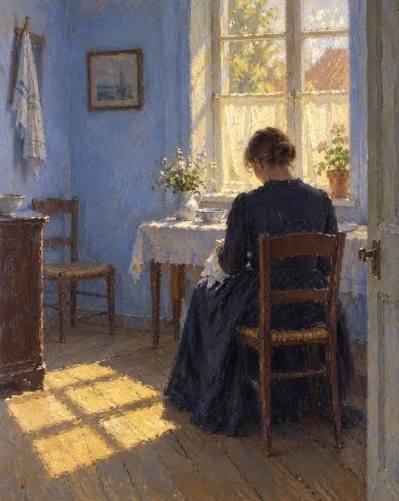
We propose an exercise: recreate the effect of light in a painting within a real space. With Anna Ancher, we could use moving cyan fabric, let light pass through it, and project a shadow onto the floor. The relationship between light, color, and shadow in the painting would take on a physical form that we could adjust and experience from within.
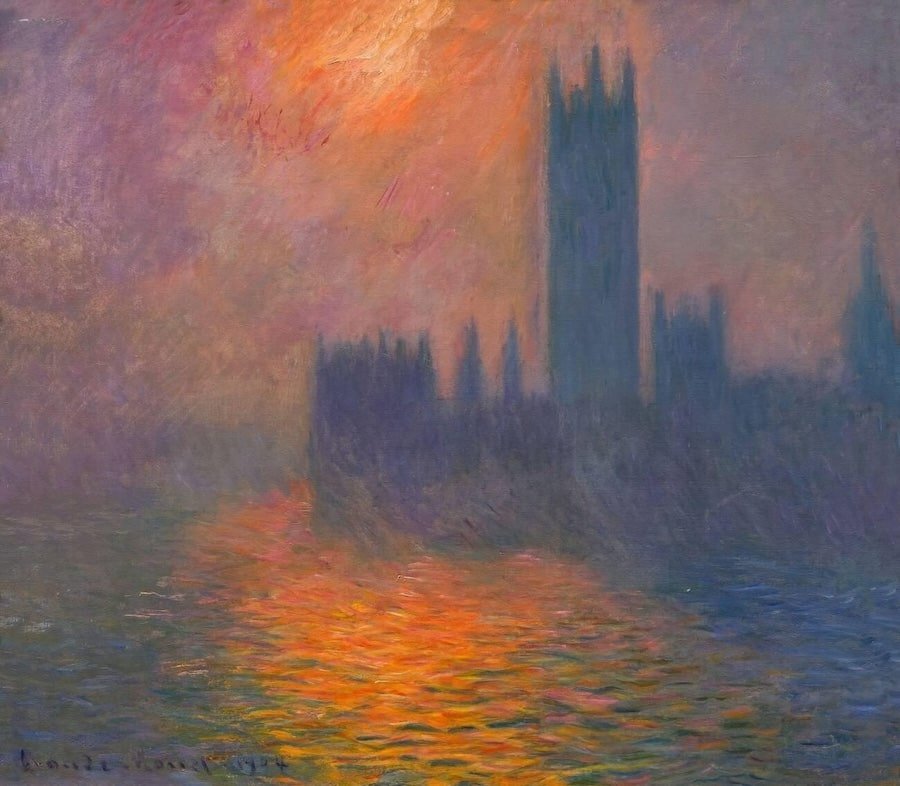
For Monet’s Le Parlement, we could try a composition inspired by Olafur Eliasson’s The Weather Project. We would recreate the painting’s light and atmosphere using diffuse light and mist, until the building’s silhouette seemed absorbed by them.
From Mondrian to Dan Flavin
Mondrian pushed abstraction so far that he reduced composition to perpendicular lines and planes of color. What might those lines resemble if we lifted them off the canvas? Lights.
In Dan Flavin’s work, we can see this kind of geometry physically built from fluorescent tubes. The lines emit light, color spreads across the walls, and the composition occupies the room. His installations bring to life relationships that we see on a flat surface in Mondrian’s paintings. Through them, we understand Mondrian better, too.
Here lies the difficulty in our exercise: how do we recreate the tension of an abstract composition through light, preserving the differences, pauses, and imbalance that make it interesting? A faithful reproduction of its geometry can miss precisely those qualities.
An exercise in Light, starting with Painting
We choose a painting and try to extract its light, leaving aside the recreation of its setting and figures. We work with materials, color, shadows, reflections, and distances, then see what needs to change for the relationships in the painting to work in physical space.
